
Endogeneity and Gaussian Copulas
Endogeneity arises when a structural model relationship is contaminated by unobserved factors that correlate with both an independent and a dependent construct, biasing the estimated path coefficient. The Gaussian copula approach is a statistical technique that lets researchers detect and correct for such endogeneity in PLS-SEM (i.e., for relationships in the structural model) without requiring an instrumental variable. It is particularly useful when no suitable instrument is available but a relationship in the model is suspected of being biased by omitted variables.
What Causes Endogeneity
Endogeneity can have various roots, such as measurement errors, simultaneous causality, common method variance, and (un)observed heterogeneity, but it most often arises from omitted variables that correlate with one or more independent variable(s) and the dependent variable(s) in the regression model (Hult et al., 2018). Omitting such variables induces a correlation between the corresponding independent variables and the dependent variables' error term: the independent variables then explain not only the dependent variable, but also the error in the model. In this context, we use the terms endogenous and exogenous to identify variables that endogeneity does (not) impact, and dependent and independent to identify constructs that explain other constructs in partial least squares structural equation modeling (PLS-SEM), or are explained by them.
Addressing Endogeneity
A simple way to address, or at least reduce, endogeneity is to specify a set of control variables that account for some of the variance in the dependent variable (Ebbes, Papies, & van Heerde, 2017). Even with careful selection of control variables, researchers must also apply a statistical approach to address endogeneity whenever a potential endogeneity problem exists. Two broad statistical approaches have been developed to examine the presence of endogeneity: the instrumental variable approach and the instrumental variable-free approach (Papies, Ebbes, & van Heerde, 2017). While the instrumental variable approach has various drawbacks, instrumental variable-free approaches offer several advantageous features (e.g., Hult et al., 2018). Among the instrumental variable-free approaches, the Gaussian copula method is particularly popular (Becker, Proksch, & Ringle, 2022; Liengaard et al., 2025; Park & Gupta, 2012).
Two Variants of the Gaussian Copula Approach
| Variant | How it works | Limitation |
|---|---|---|
| Maximum likelihood approach (original) | Estimates the regression model using an adapted maximum likelihood function that accounts for the correlation between the regressor and the error term via the Gaussian copula. | Can only account for one endogenous regressor in the model. |
| Control function approach (implemented in SmartPLS) | Adds a "copula term" to the regression equation for each endogenous regressor, similar to the control function approach for IV model estimation. Can account for multiple endogenous regressors by including multiple copula terms simultaneously. | Requires the non-normality of the endogenous variable(s) and has several additional limitations that require careful attention. |
In practice, almost all applications use the control function variant, which is the version implemented in SmartPLS. The parameter estimate of the copula term is the estimated correlation between the regressor and the error term, scaled by the variance of the error. Based on bootstrapped standard errors, a statistical test of this parameter estimate indicates whether this correlation is statistically significant, and therefore whether endogeneity problems exist (Hult et al., 2018; Papies, Ebbes, & van Heerde, 2017). A key requirement for applying the Gaussian copula approach is the non-normality of the endogenous variable(s) (Park & Gupta, 2012), which researchers must check, for example via the Cramer-von-Mises non-normality test (see also Becker et al., 2022). The approach also has several additional limitations that require careful attention in applications; for details, see Becker et al. (2022) and Eckert and Hohberger (2022).
The new and extended framework for the Gaussian copula approach proposed by Liengaard et al. (2025) addresses several of these problems and limitations. This approach is implemented in SmartPLS and can be used not only to address endogeneity in regression models, but also in other methods provided by SmartPLS, such as PLS-SEM and path analysis.
Gaussian Copula Approach in SmartPLS
Create or open a PLS path model in SmartPLS. Click the Gaussian Copula button on the menu bar; a click icon then appears on each selected relationship in the structural model (see screenshot below). Select the relationships in the structural model for which you want to detect and correct endogeneity problems using the Gaussian copula approach, and left-click on the selected relationship. A circle labeled GC then appears in the model, representing the additional Gaussian copula term for that relationship. Finally, use the PLS-SEM algorithm to estimate the model with the Gaussian copula terms, and determine their significance using bootstrapping. Use these results to assess whether the model has critical endogeneity problems that the Gaussian copula terms correct for.
Note: It is important to check the requirements of the Gaussian copula approach (e.g., non-normality of the endogenous variables) very carefully in each case (Becker et al., 2022; Liengaard et al., 2025).
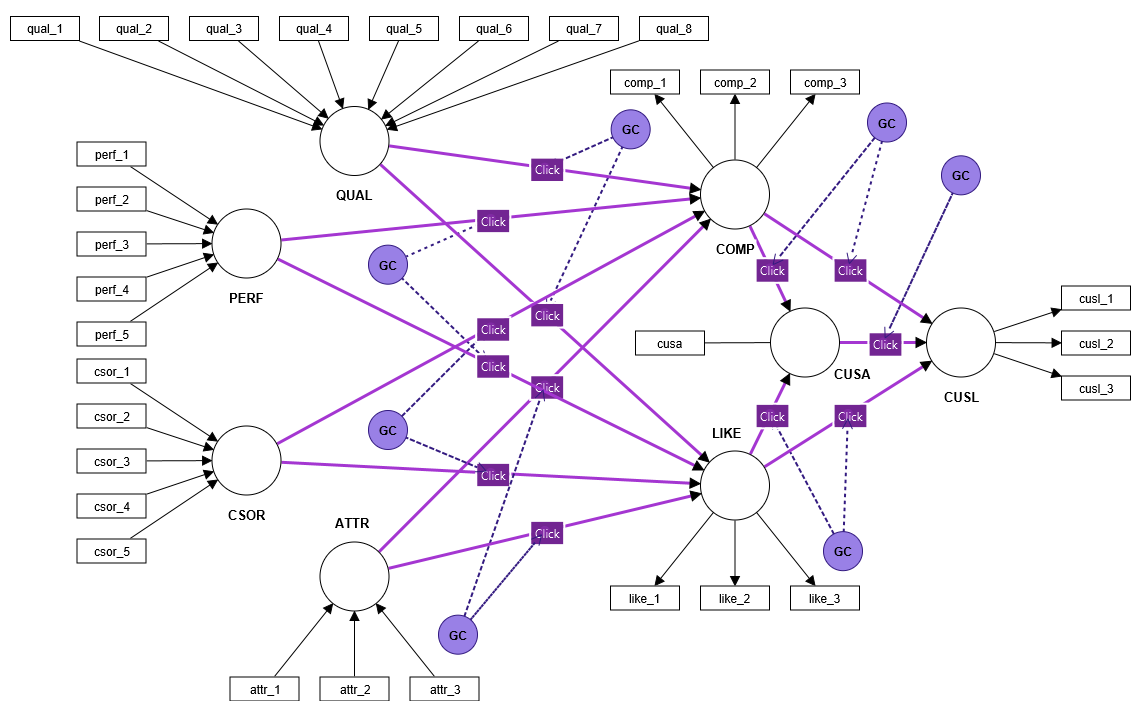
For SmartPLS, we provide sample projects for running the Gaussian copula approach in regression models. Simply download, import, and run these examples in SmartPLS.
Frequently Asked Questions
What is endogeneity, and why does it matter in PLS-SEM?
Endogeneity occurs when a structural model relationship is affected by unobserved factors that correlate with both an independent and a dependent construct, which biases the estimated path coefficient. It most often arises from omitted variables.
What causes endogeneity most often?
Endogeneity can result from measurement error, simultaneous causality, common method variance, or unobserved heterogeneity, but omitted variables that correlate with both the independent and dependent variables are the most common cause (Hult et al., 2018).
Do I need an instrumental variable to correct for endogeneity?
No. The Gaussian copula approach is an instrumental variable-free method, which makes it attractive when no valid instrument is available. It is one of several instrumental variable-free approaches, alongside the classical instrumental variable approach.
How does the Gaussian copula approach correct for endogeneity?
The version implemented in SmartPLS adds a "copula term" to the regression equation for each endogenous regressor. The parameter estimate of this term reflects the correlation between the regressor and the error term; testing it with bootstrapped standard errors shows whether the endogeneity is statistically significant.
What do I need to check before applying the Gaussian copula approach?
The endogenous variable(s) must be non-normally distributed, which can be checked with a test such as the Cramer-von-Mises non-normality test. The approach also has additional limitations that should be reviewed carefully (Becker et al., 2022; Eckert & Hohberger, 2023).
How do I apply the Gaussian copula approach in SmartPLS?
Click the Gaussian Copula button on the menu bar, select the structural model relationships you want to test, and SmartPLS adds a GC term to the model. Run the PLS-SEM algorithm to estimate the model with the copula terms, then use bootstrapping to test their significance.
Related SmartPLS Methods
References
- Becker, J.-M., Proksch, D., & Ringle, C. M. (2022). Revisiting Gaussian copulas to handle endogenous regressors. Journal of the Academy of Marketing Science, 50, 46–66.
- Ebbes, P., Papies, D., & van Heerde, H. J. (2017). Dealing with endogeneity: A nontechnical guide for marketing researchers. In C. Homburg, M. Klarmann, & A. Vomberg (Eds.), Handbook of market research (pp. 181–217). Springer.
- Eckert, C., & Hohberger, J. (2023). Addressing endogeneity without instrumental variables: An evaluation of the Gaussian copula approach for management research. Journal of Management, 49(4), 1460–1495.
- Hult, G. T. M., Hair, J. F., Proksch, D., Sarstedt, M., Pinkwart, A., & Ringle, C. M. (2018). Addressing endogeneity in international marketing applications of partial least squares structural equation modeling. Journal of International Marketing, 26(3), 1–21.
- Liengaard, B. D., Becker, J.-M., Bennedsen, M., Heiler, P., Taylor, L. N., & Ringle, C. M. (2025). Dealing with regression models' endogeneity by means of an adjusted estimator for the Gaussian copula approach. Journal of the Academy of Marketing Science, 53, 279–299.
- Papies, D., Ebbes, P., & van Heerde, H. J. (2017). Addressing endogeneity in marketing models. In P. S. H. Leeflang, J. E. Wieringa, T. H. A. Bijmolt, & K. H. Pauwels (Eds.), Advanced methods in modeling markets (pp. 581–627). Springer.
- Park, S., & Gupta, S. (2012). Handling endogenous regressors by joint estimation using copulas. Marketing Science, 31(4), 567–586.
- More literature ...
Cite correctly
Please always cite the use of SmartPLS!
Ringle, Christian M., Wende, Sven, & Becker, Jan-Michael. (2024). SmartPLS 4. Bönningstedt: SmartPLS. Retrieved from https://www.smartpls.com
