Higher-order Models
Higher-order models — also called hierarchical component models (HCMs) in the PLS-SEM literature — let researchers represent a construct at a more abstract, higher-order level while simultaneously modeling its more concrete lower-order subdimensions. Establishing a HCM most often involves a second-order model with a two-layer structure of constructs. For example, satisfaction can be measured at two levels of abstraction: a general higher-order satisfaction construct (HOC), together with several lower-order constructs (LOCs) that capture more concrete facets, such as satisfaction with the price, the service quality, the personnel, and the servicescape.
Why Use a Higher-Order Model
A HCM embraces a more general construct (the HOC), measured at a higher level of abstraction, while simultaneously including several subcomponents (the LOCs), which cover more concrete traits of this construct. HCMs help reduce the number of structural model relationships, making the PLS path model more parsimonious, while increasing the bandwidth of content covered by the respective constructs.
Types of Higher-Order Models
Establishing a HCM builds on carefully developed theoretical/conceptual considerations. On these grounds, researchers choose from four major HCM types, which differ in how the HOC relates to the LOCs and in the measurement model used to operationalize the lower-order constructs:
| HCM type | Role of the HOC | Comparable to |
|---|---|---|
| Reflective-reflective | The HOC represents a more general construct that simultaneously explains all underlying LOCs. | A reflective measurement model |
| Formative-reflective | The HOC represents a more general construct that simultaneously explains all underlying LOCs. | A reflective measurement model |
| Reflective-formative | The HOC is formed by the LOCs. | A formative measurement model |
| Formative-formative | The HOC is formed by the LOCs. | A formative measurement model |
The repeated indicators approach, the total effects analysis of a collect-type HCM (i.e., the extended repeated indicators approach; Becker et al., 2012), and the embedded and disjoint two-stage approaches (Sarstedt et al., 2019) allow modeling and estimating HCMs in PLS-SEM. Crocetta et al. (2021) further extend the higher-order PLS path modeling approach to accommodate different types of constructs. When specifying and estimating HCMs in PLS-SEM, researchers also need to consider further aspects, such as the number of indicators per LOC, the PLS-SEM algorithm weighting scheme, and the use of Mode A and Mode B weighting.
Evaluating Higher-Order Model Results
Researchers can use the SmartPLS software to model any of the four HCM types described above. When evaluating the results of a HCM estimation, researchers need to carefully assess not only the measurement models of the LOCs, but also the measurement model of the HOC. Unlike other constructs in the PLS path model, assessing the HOC is not about the relationships between the HOC and its indicator variables, but about the relationships between the HOC and its LOCs. While a PLS-SEM analysis maps these relationships as path coefficients, from a modeling perspective they correspond to loadings (for reflective-reflective and formative-reflective HCMs) or weights (for reflective-formative or formative-formative HCMs) and should be interpreted accordingly. This careful, method-appropriate interpretation matters more broadly, too: Ringle et al. (2012) offer a critical look at how PLS-SEM has been used and reported in empirical research and call for more rigorous application of the method.
Higher-Order Models in SmartPLS
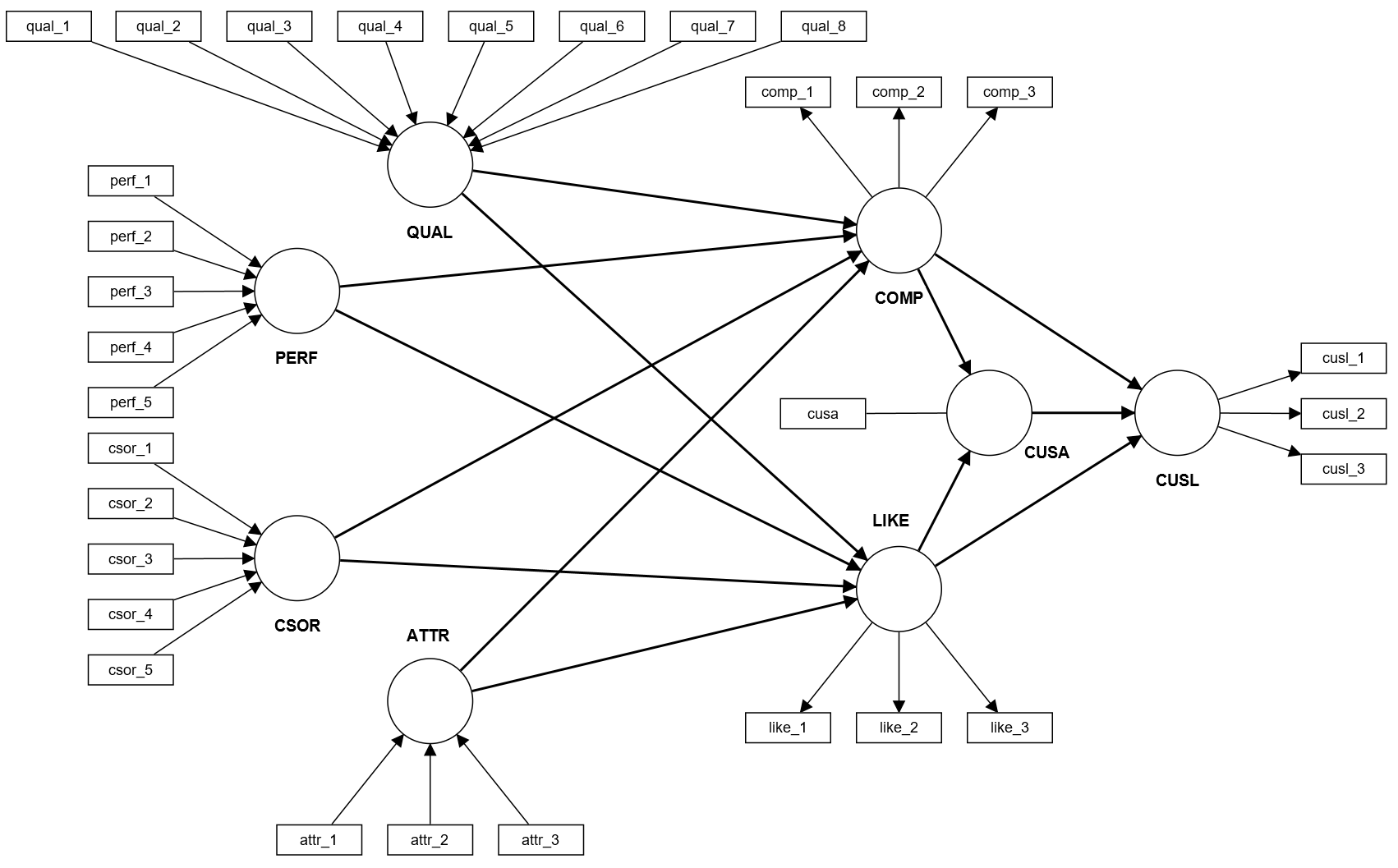
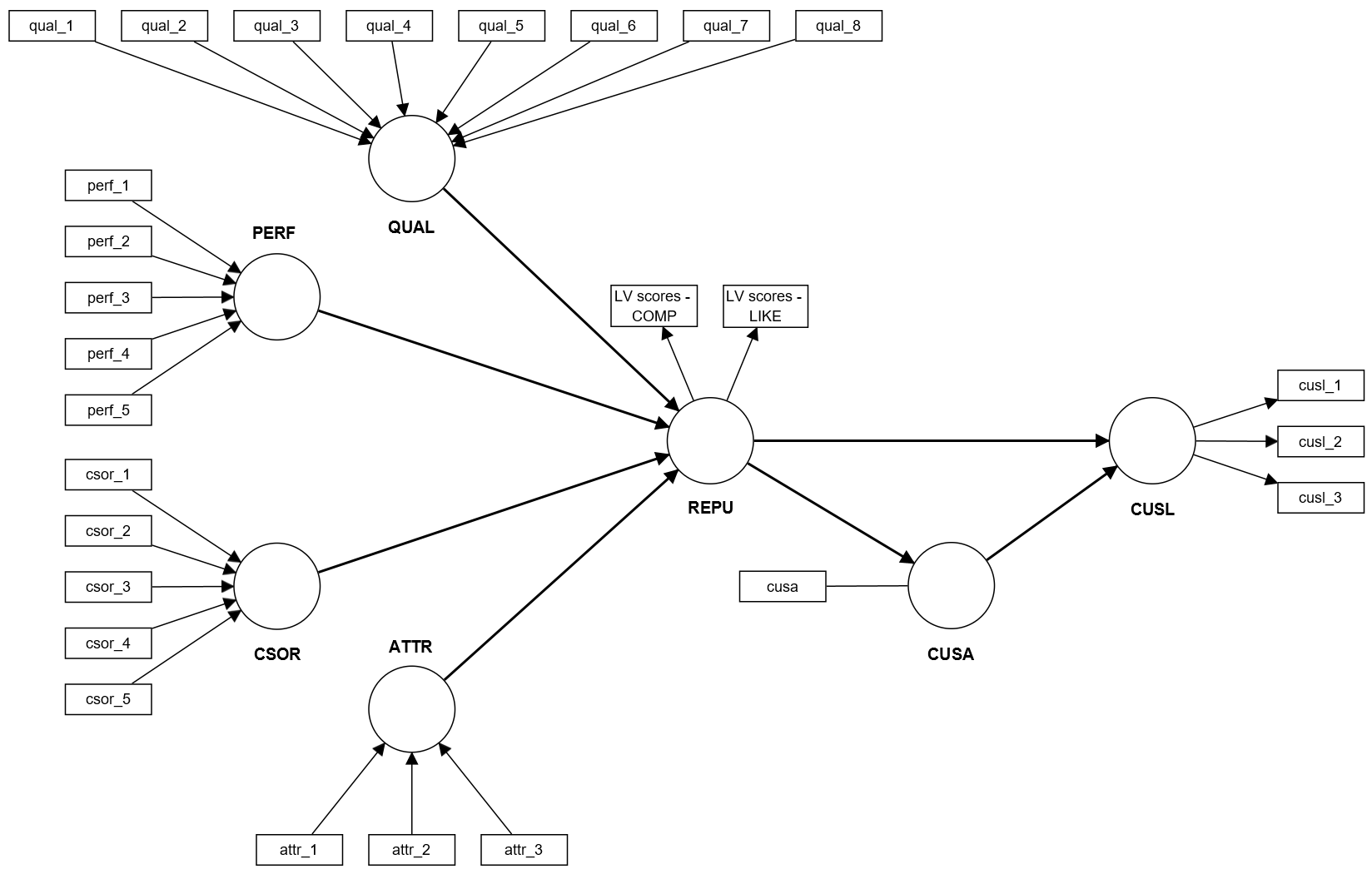
The following figures show an example of using the disjoint two-stage approach to estimate a reflective-reflective second-order model of corporate reputation (REPU), with competence (COMP) and likeability (LIKE) as first-order constructs, in SmartPLS.
Stage 1 of the disjoint two-stage approach.
Stage 2 of the disjoint two-stage approach.
Becker et al. (2023), Hair et al. (2024), and Sarstedt et al. (2019) describe the higher-order model analysis in PLS-SEM in more detail. Hauff et al. (2025) illustrate how formative measurement and hierarchical component models can generate more impactful insights in human resource management systems research.
Frequently Asked Questions
What is a higher-order model (HCM) in PLS-SEM?
A higher-order model, or hierarchical component model, represents a construct at two levels of abstraction: a higher-order construct (HOC) and several lower-order constructs (LOCs) that capture its more concrete subdimensions. HCMs make the path model more parsimonious while covering a broader range of content.
What are the four types of higher-order models?
The four types are reflective-reflective, reflective-formative, formative-reflective, and formative-formative, depending on whether the HOC explains the LOCs (like a reflective model) or is formed by them (like a formative model).
How do I estimate a higher-order model in PLS-SEM?
Common approaches include the repeated indicators approach, the extended repeated indicators approach for collect-type HCMs (Becker et al., 2012), and the embedded or disjoint two-stage approaches (Sarstedt et al., 2019). SmartPLS supports modeling all four HCM types, including the disjoint two-stage approach.
How should I interpret the relationship between the HOC and its LOCs?
Although SmartPLS reports these relationships as path coefficients, they should be interpreted as loadings in reflective-reflective and formative-reflective HCMs, or as weights in reflective-formative and formative-formative HCMs — not as ordinary structural path coefficients.
What should I consider when specifying an HCM?
Beyond choosing the HCM type, researchers should consider the number of indicators per LOC, the PLS-SEM algorithm weighting scheme, and whether Mode A or Mode B weighting is used for the LOCs.
Related SmartPLS Methods
References
- Becker, J.-M., Cheah, J. H., Gholamzade, R., Ringle, C. M., & Sarstedt, M. (2023). PLS-SEM's most wanted guidance. International Journal of Contemporary Hospitality Management, 35(1), 321–346.
- Becker, J.-M., Klein, K., & Wetzels, M. (2012). Hierarchical latent variable models in PLS-SEM: Guidelines for using reflective-formative type models. Long Range Planning, 45(5–6), 359–394.
- Crocetta, C., Antonucci, L., Cataldo, R., Galasso, R., Grassia, M. G., Lauro, C. N., & Marino, M. (2021). Higher-order PLS-PM approach for different types of constructs. Social Indicators Research, 154(2), 725–754.
- Hair, J. F., Sarstedt, M., Ringle, C. M., & Gudergan, S. P. (2024). Advanced issues in partial least squares structural equation modeling (PLS-SEM) (2nd ed.). Sage.
- Hauff, S., Richter, N. F., & Ringle, C. M. (2025). Human resource management systems research: How to gain impactful insights through formative measurement and hierarchical component models. The International Journal of Human Resource Management, 36(4), 611–635.
- Ringle, C. M., Sarstedt, M., & Straub, D. W. (2012). Editor's comments: A critical look at the use of PLS-SEM in "MIS Quarterly." MIS Quarterly, 36(1), iii–xiv.
- Sarstedt, M., Hair, J. F., Cheah, J.-H., Becker, J.-M., & Ringle, C. M. (2019). How to specify, estimate, and validate higher-order constructs in PLS-SEM. Australasian Marketing Journal, 27(3), 197–211.
- More literature ...
Cite correctly
Please always cite the use of SmartPLS!
Ringle, Christian M., Wende, Sven, & Becker, Jan-Michael. (2024). SmartPLS 4. Bönningstedt: SmartPLS. Retrieved from https://www.smartpls.com
