
Mediation
Mediation occurs when a third variable, the mediator, transmits the effect of an exogenous construct on an endogenous construct in a PLS path model: a change in the exogenous construct produces a change in the mediator variable, which in turn produces a change in the endogenous construct. The mediator therefore governs the nature of the relationship between two constructs — that is, the underlying mechanism or process that connects them, rather than just their direct relationship. A path model can include a single mediator or, in a multiple mediator analysis, several mediators simultaneously.
Analyzing a Single Mediator
Analyzing the strength of the mediator variable's relationships with the other constructs allows researchers to substantiate the mechanisms underlying the cause-effect relationship between an exogenous construct and an endogenous construct. Hair et al. (2027) describe the systematic mediator analysis process in PLS-SEM in more detail; see also Nitzl et al. (2016), Cepeda et al. (2017), and Memon et al. (2018).
The following figure shows a simple mediator model, where is the direct effect, is the indirect effect, and the direct effect plus the indirect effect equals the total effect:
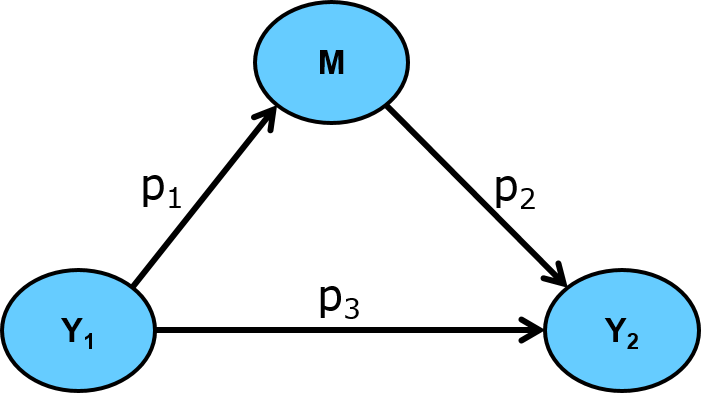
To analyze a mediator model, Zhao et al. (2010) suggest a decision process, shown in the following figure, which Hair et al. (2017) also propose for use in PLS-SEM:
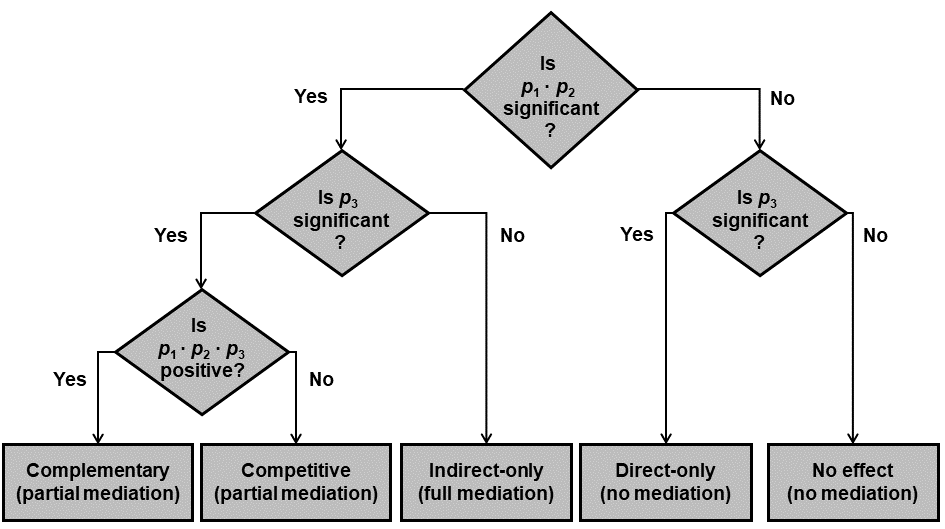
Based on the indirect effect, the researcher then determines whether mediation occurs and, if so, what kind of mediation is present.
Analyzing Multiple Mediators
Researchers can also apply this model to situations with multiple mediators, as shown in the following figure:
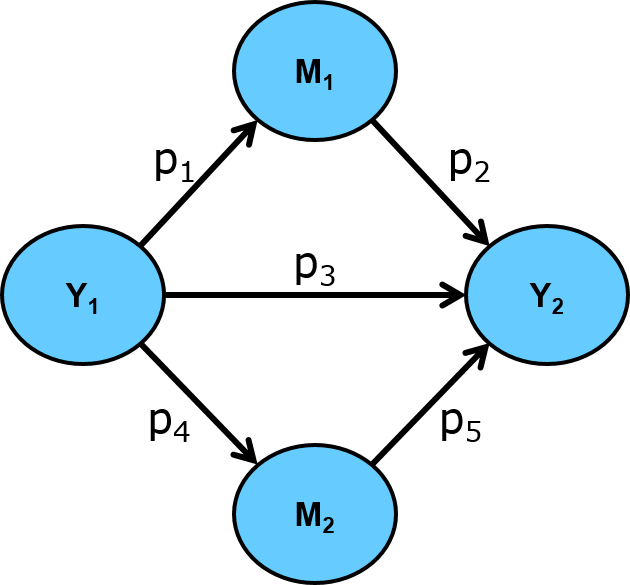
In this figure, constructs and mediate the relationship between constructs and in parallel. If an additional relationship from construct to is added, the situation is described as serial mediation (i.e., mediator follows ).
When considering multiple mediators, researchers should analyze the model that includes all relevant mediators at the same time (as shown in the figure above), using the same analysis procedure described above (Hair et al., 2027; Zhao et al., 2010). This also allows analyzing the total indirect effect for the total mediation via both mediators and , or, alternatively, the specific indirect effects per mediator variable (i.e., for the mediator and for the mediator).
Mediation can also be combined with moderation in PLS-SEM to carry out a moderated mediation or conditional process analysis (Cheah et al., 2021; Hair et al., 2022; Memon et al., 2026; Sarstedt et al., 2020).
Mediation in SmartPLS
SmartPLS supports modeling and analyzing mediators. The following model shows the corporate reputation model example, where CUSA mediates the relationships between COMP and CUSL, as well as between LIKE and CUSL.
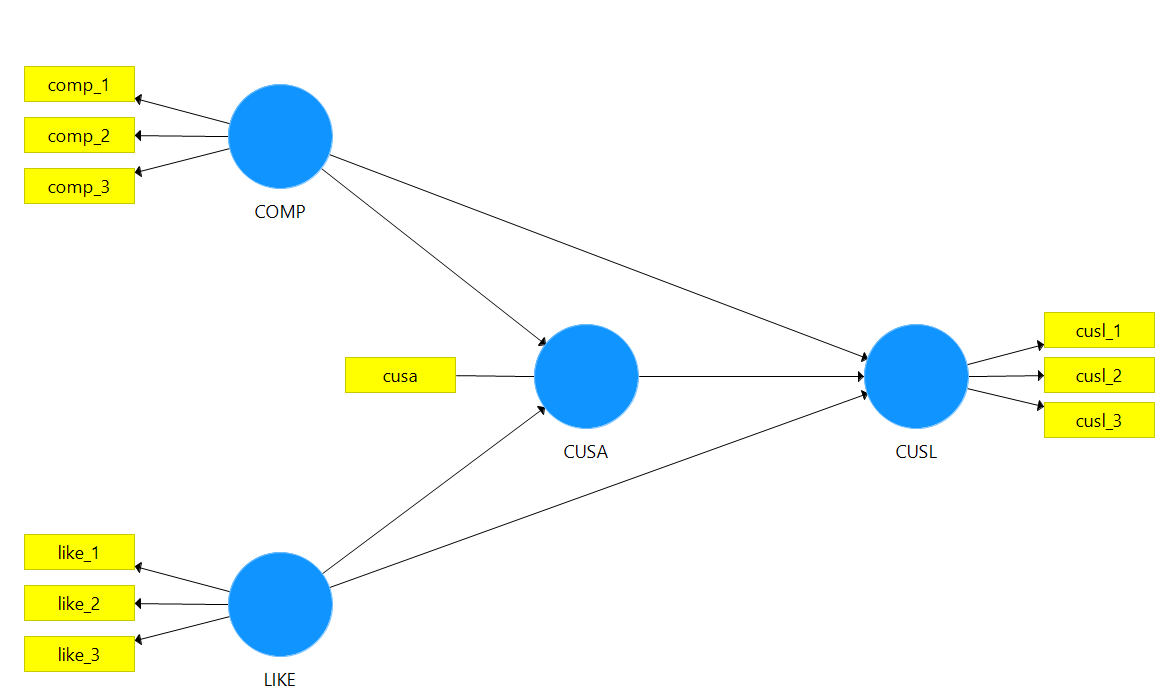
In SmartPLS, the results of the PLS-SEM algorithm and the bootstrap procedure include the direct effect, the total indirect effect, the specific indirect effects, and the total effect. These outcomes, available in the SmartPLS results reports, allow you to conduct a mediator analysis (e.g., as suggested by Hair et al., 2017). Both single and multiple mediation models (i.e., parallel and serial mediation) can be analyzed using the SmartPLS results.
Frequently Asked Questions
What is mediation in PLS-SEM?
Mediation occurs when a third variable, the mediator, transmits the effect of an exogenous construct on an endogenous construct. Analyzing the mediator's relationships with the other constructs helps substantiate the underlying mechanism connecting the two constructs.
How is the total effect related to the direct and indirect effect?
The total effect equals the direct effect plus the indirect effect. In a simple mediator model, if is the direct effect and is the indirect effect through the mediator, the total effect is plus .
Can a PLS path model include more than one mediator?
Yes. A model can include a single mediator or, in a multiple mediator analysis, several mediators that operate in parallel or in series. Serial mediation occurs when one mediator also affects another mediator in the chain.
What is the difference between parallel and serial mediation?
In parallel mediation, multiple mediators each transmit the effect between the same two constructs independently of one another. In serial mediation, one mediator also has a relationship with another mediator, so the mediators form a chain.
Can mediation be combined with moderation?
Yes. Mediation and moderation can be combined to conduct a moderated mediation or conditional process analysis.
Which SmartPLS results do I need for a mediation analysis?
The results of the PLS-SEM algorithm and the bootstrap procedure provide the direct effect, the total indirect effect, the specific indirect effects, and the total effect needed for a mediator analysis, for both single and multiple mediator models.
Related SmartPLS Methods
References
- Cepeda, G., Nitzl, C., & Roldán, J. L. (2017). Mediation analyses in partial least squares structural equation modeling: Guidelines and empirical examples. In H. Latan & R. Noonan (Eds.), Partial least squares path modeling: Basic concepts, methodological issues and applications (pp. 173–195). Springer.
- Cheah, J. H., Nitzl, C., Roldán, J. L., Cepeda Carrión, G., & Gudergan, S. P. (2021). A primer on the conditional mediation analysis in PLS-SEM. ACM SIGMIS Database: the DATABASE for Advances in Information Systems, 52, 43–100.
- Hair, J. F., Hult, G. T. M., Ringle, C. M., & Sarstedt, M. (2027). A primer on partial least squares structural equation modeling (PLS-SEM) (4th ed.). Sage.
- Memon, M. A., Cheah, J.-H., Ramayah, T., Ting, H., & Chuah, F. (2018). Mediation analysis: Issues and recommendations. Journal of Applied Structural Equation Modeling, 2(1), i–ix.
- Memon, M. A., Thurasamy, R., Cheah, J.-H., Ting, H., Kreienbaum, C., & Ringle, C. M. (2026). Moderated mediation analysis using SmartPLS: A tutorial for business researchers. Journal of Applied Structural Equation Modeling, 10(1), 1–28.
- Nitzl, C., Roldán, J. L., & Cepeda Carrión, G. (2016). Mediation analysis in partial least squares path modeling: Helping researchers discuss more sophisticated models. Industrial Management & Data Systems, 119(9), 1849–1864.
- Sarstedt, M., Hair, J. F., Nitzl, C., Ringle, C. M., & Howard, M. C. (2020). Beyond a tandem analysis of SEM and PROCESS: Use of PLS-SEM for mediation analyses! International Journal of Market Research, 62(3), 288–299.
- Zhao, X., Lynch, J. G., & Chen, Q. (2010). Reconsidering Baron and Kenny: Myths and truths about mediation analysis. Journal of Consumer Research, 37(2), 197–206.
- More literature ...
Cite correctly
Please always cite the use of SmartPLS!
Ringle, Christian M., Wende, Sven, & Becker, Jan-Michael. (2024). SmartPLS 4. Bönningstedt: SmartPLS. Retrieved from https://www.smartpls.com
